It’s easy to absent mindedly imagine the Internet as “the cloud” – a vast, ethereal accumulation of information held in the databanks of billions of computers; a collection of large and small networks connected by satellites and WiFi.
 Fibre Optics
Image: Flickr/placbo
To some it may seem almost bizarre to think that this technology, once deemed the province of science fiction, is in fact connected using cables – a global extension of the familiar tubes that clutter our offices and the bedroom floors of teenagers. The extensive network consists of over 980,000 km of fibre optic cables buried beneath the seabed between continents, spanning the world’s seas and oceans. The mountain of data available is housed across innumerable individual networks and a multitude of data centres across the globe (Google alone has 12 data centres across America, Europe and Asia, allowing them to process over 20 billion web pages per day).
There are currently 263 active cables in place, with a further 22 planned in coming years. It is estimated that between 95% and 99% of all Internet usage is carried along these cables. The huge network, made up of cables, Internet exchange points, cable landing stations and roadside regeneration huts, carries billions of gigabytes of data every month.
In this age of connectivity, even the most mundane elements of our daily lives rely on access to the Internet. In a typical British household, you will find between three and four smart phones, a laptop, a PC, and at least one touchpad. Yet it is not simply computers and mobile devices that now demand bandwidth. From everyday items, like toothbrushes, to essential medical technology, such as pacemakers, our reliance on the Internet and our need for greater and more reliable bandwidth is steadily growing. This growing network of people and Internet-enabled devices, processes, systems and services is referred to as the Internet of Things.
Global Internet traffic in 2013 was approximately 51 exabytes (that’s 51 billion gigabytes) per month. This will increase to 132 exabytes by 2018
According to Cisco’s Connections Counter, in July 2013 the Internet of Things consisted of over 10 billion things connected to the Internet. It is estimated that this will increase to around 50 billion by 2020. All of these connections combine to generate an astounding amount of global Internet traffic. As part of their Visual Networking Index, Cisco have calculated that global Internet traffic in 2013 was approximately 51 exabytes (that’s 51 billion gigabytes) per month. They forecast that this will increase to 132 exabytes by 2018.
 Smart Technology: the dawn of the Internet of Things
Image: Flickr/Leon Lee
Bandwidth capability will need to increase in tandem with this rise in demand to support the developments in technology and commercial opportunity brought on by the Internet of Things. In April 2014, telecommunications research and consulting firm, TeleGeography reported that demand for international bandwidth increased by 39% to 138 terabytes per second (TBPS) in 2013 – over 4 times more than the global demand in 2009 (30 TBPS). Demand is expected to increase threefold again by 2018.
Telecommunication companies and content providers alike are working on new technologies and projects to facilitate the rapidly increasing traffic and the demand for improved broadband. Giants such as Google and Microsoft are now focusing on connecting data centres to one another, rather than connecting end users to data centres. Projects are already underway to improve the capacity of the cables themselves; the new SeaMeWe 5 100G cable system will provide 24Tbs per second, considerably more than the existing cable system.
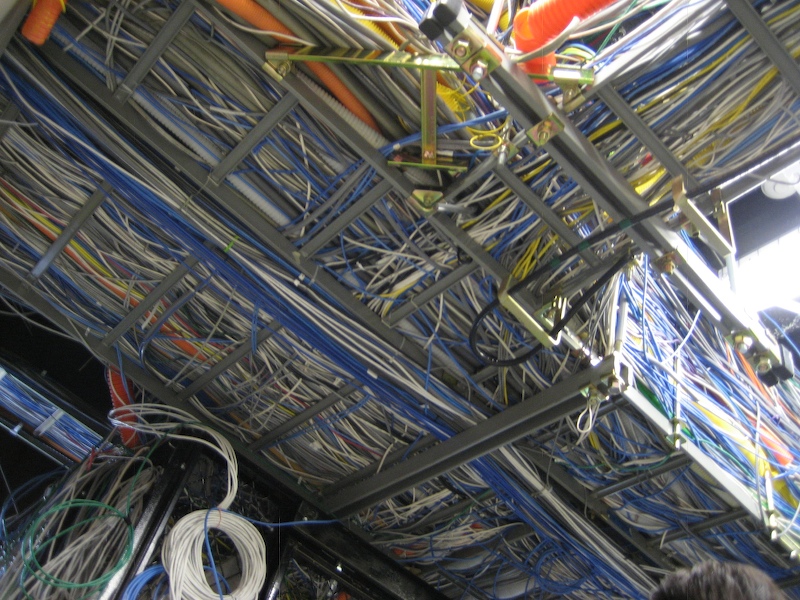 Cable chaos? The ceiling of a data exchange
Image: Flickr/Xeni Jardin
To ensure the impact of any future breakages and faults is minimised, operators are developing contingency plans which incorporate alternative connections between continents, such as secondary lines and satellite uplinks, to enable a faster reroute of traffic. Operators are also considering alternative locations for cable systems via South America and the Arctic, and encouraging the creation of terrestrial systems where possible – especially in bottlenecked waters like the Suez Canal.
Addressing concerns of sabotage and data terrorism, security companies and software developers have created both physical and cyber security systems at various points in the infrastructure to protect it from abuse, from firewall systems for data centres to cloud-based Internet intelligence and intrusion prevention systems for networks.
While the number of connectable devices outweighs the amount of people in the world, less than 40% of the global population has access to the Internet.
In addition to improving and protecting the current infrastructure, projects focused on bringing Internet connectivity to those in rural and remote areas of the world are rapidly developing. While the number of connectable devices outweighs the amount of people in the world, less than 40% of the global population has access to the Internet.
The pilot of Google’s Project Loon, developed by Google’s X Lab, was launched in June 2013, and comprises a fleet of solar-powered “smart” balloons floating in the stratosphere (approximately 20km above the Earth). The balloons connect to special antenna on the ground to deliver Internet connection to even the most remote location. The system calculates where each balloon is needed to get the optimal signal, and uses the layers of wind in the stratosphere to position each balloon to create a viable Internet network. A similar project is being developed by Facebook’s Connectivity Lab. Both Google and Facebook recently acquired companies that make high-altitude drones with the intention of using the technology to bring the Internet to the remaining 5 billion people on earth, predominantly in low to middle income countries, who do not yet have access.
In Africa, whilst 70% of the population have WiFi-enabled devices such as mobile phones, only 10% have access to the Internet. This is because many areas are extremely remote, and do not have the infrastructure in place to be connected to the Internet backbone (the submarine cabling network). Most significantly, however, a huge proportion of homes across the continent cannot afford 3G coverage.
Some African governments, such as Tshwane (the South African capital municipality), have tried to address this problem. Using the glut of WiFi-enabled devices and the explosion of new radio technology start-ups (triggered by Motorola releasing teams of engineers to start their own companies), Tshwane has begun to roll out a scheme to provide WiFi for low-income communities. By the end of January 2014, over 25,000 people had benefitted from the initiative. The scheme is to be rolled out to a further 1 million people by the end of 2014, and to a total of 3 million by the end of 2015.
 Project Loon
Image: Flickr/iLighter
Bridging the global information divide created is the objective of a number of initiatives, including Outernet and Oluvus, two start-ups working towards ubiquitous and democratic access to the Internet.
Outernet hopes to enable the circumvention of Internet censorship and political control of the web by developing free globally accessible Internet connectivity. The organisation is currently developing a network of miniature satellites that will work in conjunction with existing geostationary satellites already in orbit. These will connect to the Internet through ground stations, up-linking data packets requested by a community as a whole. The packets will be broadcast in loops so that the data is continuously updated even if signal is poor.
Oluvus, set up by the campaign group A Human Right, is preparing to launch its cable-focused services later this year. The company will endeavor to provide places like refugee camps with Internet access, offering some of the world’s most vulnerable people access to information and opportunities for growth through technology.
Campaign group ‘A Human Right’ has also successfully ensured high speed Internet access reaches the 4,200 citizens of St Helena, the world’s most remote island located in the Atlantic Ocean, which has until now been almost entirely isolated from the global communication network. The campaign group, with the support of the UN, successfully lobbied for the proposed route of the new South Atlantic Express cable to be moved 500km, bringing it close enough to the island for it to be connected to the cable system.
More than 4,000 scientists in the Antarctic are producing significantly more data than they can export using the existing communications infrastructure
Improving Internet connectivity in remote areas will not only have a profound effect on the billions of people in low to middle income countries who are not currently ‘plugged in’ – it will also assist the communication of pivotal research in remote locations such as the Antarctic, which currently struggles with intermittent connection. More than 4,000 scientists in the Antarctic are producing significantly more data than they can export using the existing communications infrastructure, which relies mostly on geostationary satellites. These satellites tend to only work for stations along the coast and typically with low data transfer rates and unreliable reception.
With increasingly important data on climate change being bottlenecked at ground level, international governments, the world of academia and big businesses are working together to investigate and develop a number of possible solutions to solve the problem. These include connecting Antarctica to the Internet backbone’s extensive network of submarine cables and using new and improved satellite technology specifically designed for the task of extracting research data from the region.
 Antarctica: The Final Frontier
Image: Wikimedia/ravas51
Using cables to connect the icy continent to the global network is likely to be less expensive than using satellites, and the fibre optic cables are capable of transferring larger amounts of data. They would also provide access to stations away from the coastline. With only three months of the year yielding high enough temperatures to provide access to the cable network under the ice, and the challenges created by the movement of the ice shelf itself (around 10 metres of movement each year), cabling has not yet proven feasible and the antarctica remains a final frontier for the submarine cabling industry.
Visions for the long term future see a network transmitting at up to a terabyte per second – that’s up to 1,048,576 MB/s.
Meanwhile, a programme supported by the Australian Space Research Programme (ASRP), Antarctic Broadband is using small-satellite technology customised to the needs of the users. Each will be placed into opposing highly elliptical orbits ensuring that the satellites will “dwell” over the South Pole for around 18 hours a day. With each satellite orbiting the Earth in opposing phases, the continent will receive continuous coverage. Using radio communication and highly directional transmitting and receiving antennas will allow for hugely increased data links.

As engineers and scientists navigate a stronger communications path to this final frontier in the South, parallel communication technologies used by top physicists and powerful research agencies offer a glimpse into what the Internet of the future may look like. While industry professionals ponder the possibility of bringing an Internet connection speed of 10 gigabits per second to the public (1,000 times faster than current rates), NASA has successfully demonstrated data transfer speeds of a whopping 91 gigabits per second with a direct connection through their shadow network ESnet. This is a rate equates to transferring the a blueray disc of data every 2.1 seconds.
Visions for the long term future see a network transmitting at up to a terabyte per second – that’s up to 1,048,576 MB/s, a rate 100,000 times faster than the connection of the average home today. Researchers from NASA and MIT have also been successfully working on transmitting reliable wireless Internet connectivity to entirely new frontiers: the moon, with hopes of providing transmission capabilities on deep space missions to Mars and beyond in the future.
It is clear that the future will hold many more new, novel and transformative ways for humans to connect across vast physical distances, as we continue to build a world in which geographical location is of scant consequence. The die is yet to be cast on how those interactions will be characterised and the longer term impact these new and powerful connections will have on the development of global society.
Even seemingly philanthropic endeavours, such as Google’s project ‘Loon’, cannot be separated from the underlying commercial value of opening new markets to the Internet.
Most recognise the web’s power to catalyse great change, to grant voices to the disenfranchised and provide those who would otherwise remain stuck in the margins with direct access to knowledge. The Internet is the carrier of our commerce, an ever expanding library of our deeds, and a great forum traversing social, political, geographical — even linguistic divides.

What remains unclear, and which fragments opinion, is the question of Internet ownership and data rights. For the firms that own the hardware that makes up the backbone of the web, and the providers who buy their bandwidth, money remains the primary end-goal. Even seemingly philanthropic endeavours, such as Google’s project ‘Loon’, cannot be separated from the underlying commercial value of opening new markets to the Internet. At the same time, many governments seek to tap this endless stream of information for the purposes of surveillance and censorship, citing the need to combat greater threats.
Fighting the battle to place internet in the hands of the people, we see projects like the Outernet who seek to ensure freedom from corporate and political influence, and the creation of a web that does not discriminate, while campaigners for net neutrality go even further, and wish to codify the values of openness on which the Internet was founded in the very laws of the land.
What the future holds for the Internet and its long term impact on the world is uncertain, but it is easy to acknowledge that its physical and conceptual form plays, and will come to play, a huge and diverse role in the lives of many, hinging crucially on the actions and decisions of countless individuals, corporations and institutions who are shaping what the network is today and what it stands to become.








 Articles


0 commentaires:
Enregistrer un commentaire